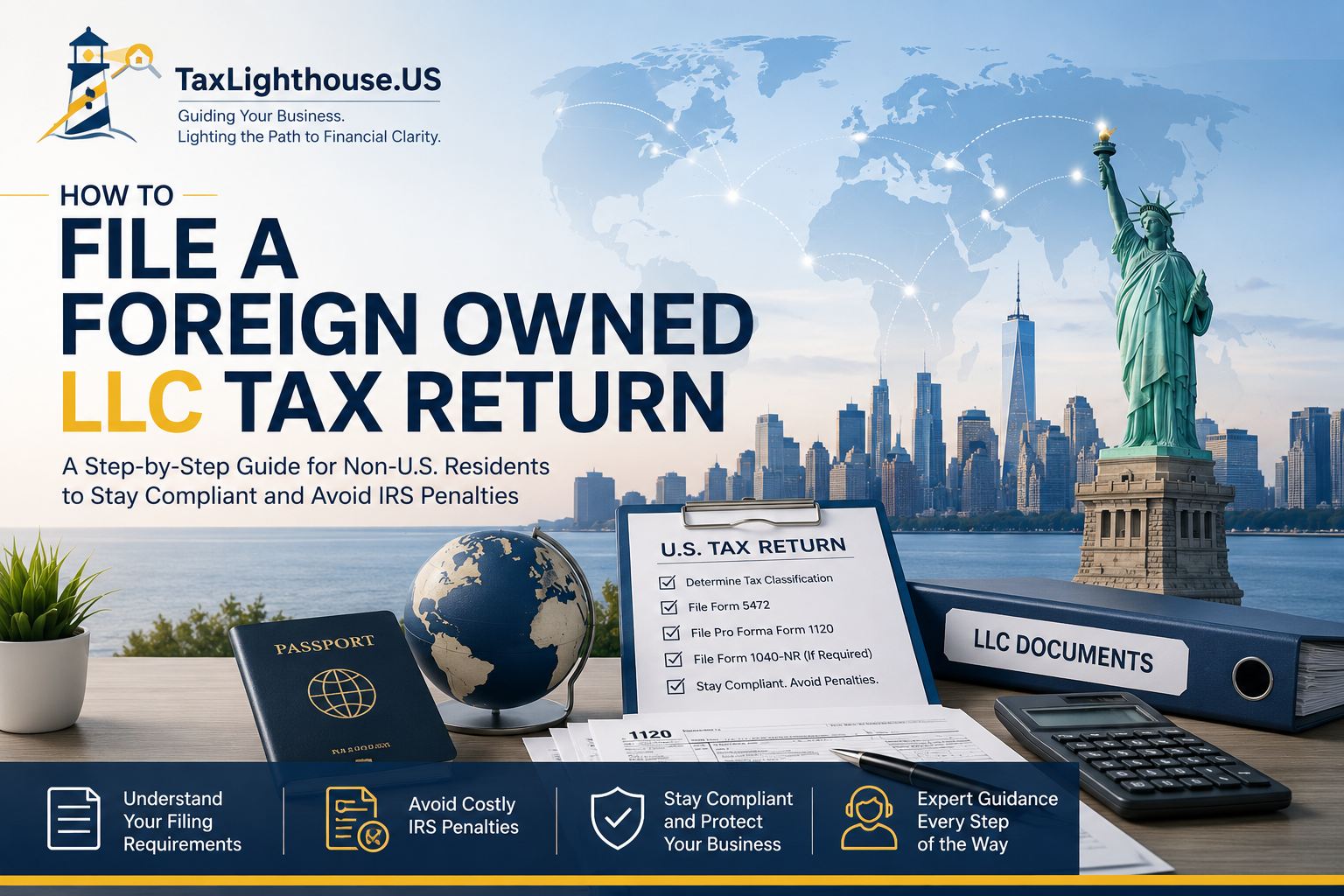
How To File a Foreign-Owned LLC Tax Return
Starting a U.S. LLC as a non-U.S. resident can create excellent business opportunities, but it also comes with important IRS filing requirements. Many foreign business owners mistakenly assume that no tax return is required if the company has little or no income. In reality, foreign-owned LLCs often have annual filing obligations regardless of profitability.This guide explains how to file a foreign-owned LLC tax return and avoid costly IRS penalties.
What Is a Foreign-Owned LLC?
A foreign-owned LLC is generally a U.S. Limited Liability Company owned by one or more individuals who are not U.S. citizens or U.S. tax residents.
Common examples include:
- A non-U.S. resident owning a Wyoming LLC
- A non-U.S. resident owning a Delaware LLC
-A foreign company owning a U.S. LLC
For federal tax purposes, most single-member foreign-owned LLCs are treated as disregarded entities unless another tax election has been made.
Step 1: Determine Your LLC's Tax Classification
Before filing, you must determine how your LLC is taxed.
Single-Member LLC
Typically treated as a disregarded entity.
Common filings may include:
- Form 5472
- Pro Forma Form 1120
- Form 1040-NR (if U.S. trade or business income exists)
Multi-Member LLC
Generally taxed as a partnership.
Common filings may include:
Form 1065Schedule K-1 for each member
LLC Electing S Corporation or C Corporation Status
Additional filings may be required depending on the election made with the IRS.
Step 2: Determine Whether You Have U.S. Trade or Business Income
The next step is determining whether your activities create Effectively Connected Income (ECI) within the United States.
Examples that may create U.S. taxable income include:
- Providing services while physically present in the United States
- Operating a U.S. office or warehouse
- Employing workers in the United States
- Certain U.S.-based business activities
If ECI exists, the foreign owner may need to file Form 1040-NR and pay U.S. income tax.
Step 3: Prepare Form 5472
Most foreign-owned single-member LLCs are required to file Form 5472.
Form 5472 reports transactions between:
- The LLC and its foreign owner
- The LLC and related foreign parties
Reportable transactions often include:
- Capital contributions
- Owner withdrawals
- LoansReimbursements
- Payments between the owner and the company
Even simple transfers of money may need to be reported
Step 4: Prepare Pro Forma Form 1120
Foreign-owned disregarded LLCs generally submit Form 5472 together with a Pro Forma Form 1120.
The Form 1120 serves primarily as a cover page for the Form 5472 filing.
Many foreign business owners mistakenly believe Form 1120 is only for corporations. However, it is also used for Form 5472 reporting by foreign-owned disregarded entities.
Step 5: Determine Whether Form 1040-NR Is Required
A foreign owner may also need to file Form 1040-NR if:
- The LLC generated Effectively Connected Income
- The owner performed services in the United States
- Other U.S.-source taxable income exists
This return reports the owner's U.S. taxable income and calculates any tax due.
Step 6: Gather Required Documents
Before preparing the return, collect:
- EIN confirmation letter
- LLC formation documents
- Bank statements
- Income records
- Expense records
- Prior-year tax returns
- Records of owner contributions and withdrawals
Proper documentation helps ensure accurate reporting and supports your filings if questions arise.
Common Filing Scenarios
Scenario 1: No Income, No Activity
Even if the LLC had no sales, Form 5472 may still be required if there were reportable transactions such as owner funding.
Scenario 2: Online Business With Foreign Operations
If operations occur entirely outside the United States, U.S. income tax may not be due. However, Form 5472 filing requirements often still apply.
Scenario 3: U.S. Business Activity
If the LLC conducts business within the United States, additional tax returns and tax payments may be required.
Penalties for Not Filing
The IRS imposes substantial penalties for failure to file Form 5472.
The penalty starts at $25,000 per year for:
- Failure to file
- Late filingIncomplete filing
- Incorrect reporting
Additional penalties may apply if the issue remains unresolved.
Filing Deadlines
For calendar-year entities, filings are generally due on April 15 following the tax year.
Extensions may be available if filed properly before the original due date.
Always verify current IRS deadlines and requirements before filing.
How TaxLighthouse Can Help
At TaxLighthouse.us, we assist foreign business owners with:
- Form 5472 preparation
- Pro Forma Form 1120 filing
- Form 1040-NR preparation
- Foreign-owned LLC compliance
- EIN applicationsIRS notice responses
Whether your LLC is formed in Wyoming, Delaware, New Mexico, Florida, or another state, we can help ensure your U.S. filing requirements are handled correctly.
Final Thoughts
Foreign-owned LLC tax filing requirements are often more complex than many business owners expect.
Even businesses with no U.S. tax liability may still have mandatory IRS reporting obligations.
Understanding the filing requirements early can help avoid expensive penalties and keep your business compliant with U.S. tax laws.
Need help filing a foreign-owned LLC tax return?
Contact TaxLighthouse.us
for professional assistance and compliance support.