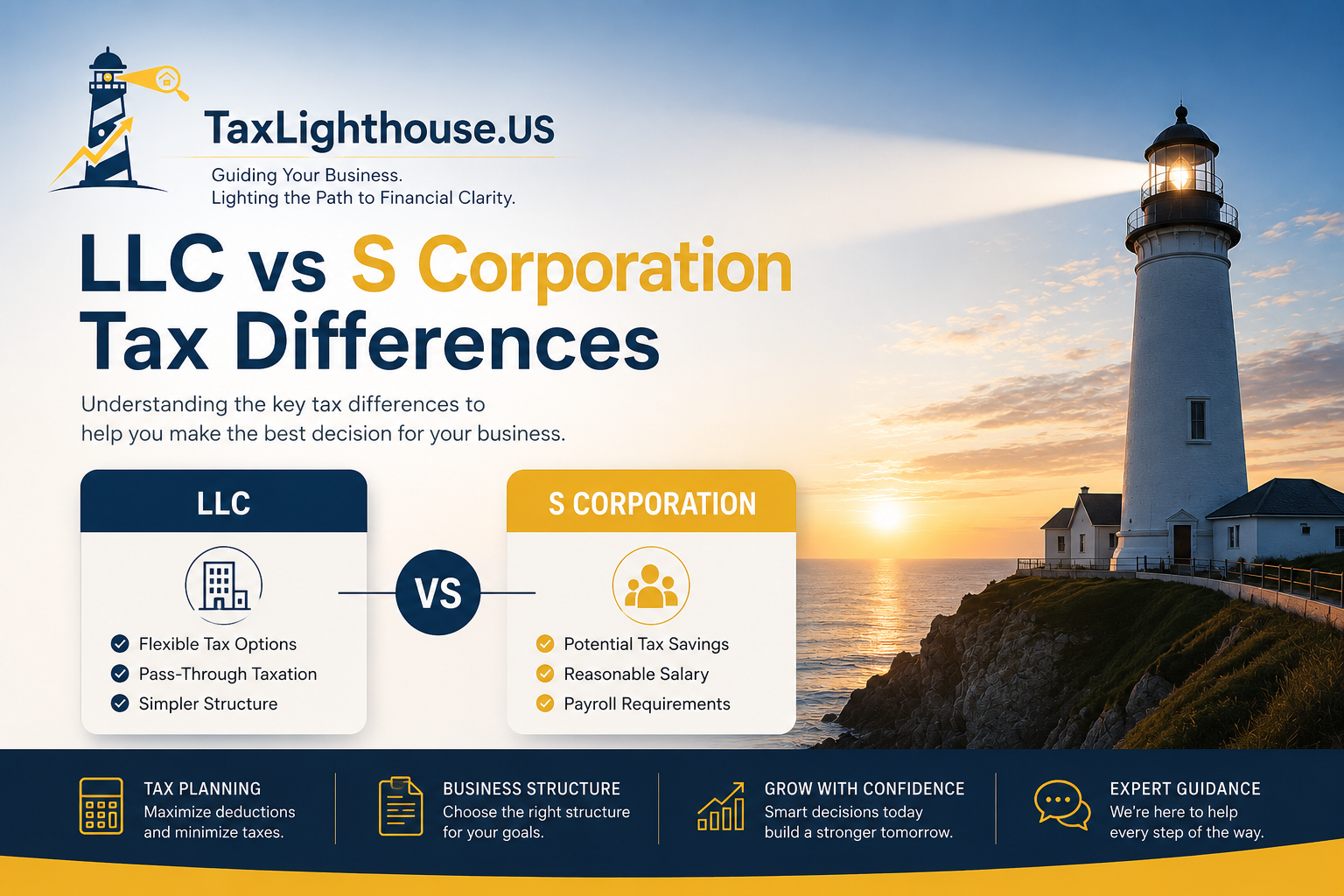
LLC vs S Corporation: Understanding the Tax Differences
One of the most common questions business owners ask is whether they should operate as an LLC or elect S Corporation tax status. While both structures offer liability protection, the tax treatment can be very different and may significantly impact your overall tax liability.
Understanding the differences can help business owners make informed decisions and potentially save thousands of dollars in taxes.
What Is an LLC?
A Limited Liability Company (LLC) is a legal business structure created under state law. An LLC provides liability protection, meaning the owners' personal assets are generally protected from business debts and lawsuits.
For federal tax purposes, a single-member LLC is typically treated as a disregarded entity, while a multi-member LLC is generally taxed as a partnership unless another tax election is made.
The LLC itself is not a tax classification. Instead, it can choose how it wants to be taxed.
What Is an S Corporation?
An S Corporation is not a legal entity type but rather a tax election made with the IRS by filing Form 2553.
Businesses that qualify can elect S Corporation status to receive pass-through taxation while potentially reducing self-employment taxes.
An LLC can elect to be taxed as an S Corporation without changing its legal structure.
How LLC Taxation Works
A single-member LLC generally reports income and expenses on Schedule C of the owner's personal tax return.
For example:
- Business Profit: $100,000
- Income Tax: Based on personal tax brackets
- Self-Employment Tax: Applies to the entire $100,000
The owner pays:
- Federal Income Tax
- State Income Tax (if applicable)
- Self-Employment Tax of approximately 15.3% on net earnings
Because the entire profit is subject to self-employment tax, the overall tax burden can be substantial as profits increase.
How S Corporation Taxation Works
With an S Corporation election, the owner is generally required to pay themselves a reasonable salary through payroll.
For example:
- Business Profit: $100,000
- Owner Salary: $50,000
- Remaining Profit Distribution: $50,000
The salary portion is subject to payroll taxes.
However, the remaining profit distribution is generally not subject to self-employment tax.
This is one of the primary reasons many profitable businesses elect S Corporation status.
Example Tax Comparison
Assume a business earns $100,000 before owner compensation
LLC Taxation:
- Business Profit: $100,000
- Subject to Self-Employment Tax: $100,000S Corporation Taxation
- Salary: $50,000Distribution: $50,000
- Subject to Payroll Tax: $50,000
In this simplified example, the S Corporation may significantly reduce employment taxes compared to a standard LLC.
Actual savings depend on many factors, including income level, reasonable compensation requirements, state taxes, and business expenses.
Advantages of an LLC
Simplicity
LLCs generally have fewer compliance requirements and less paperwork.
Lower Administrative Costs
No payroll requirement for single-member LLC owners.
Flexible Tax Options
An LLC can choose to be taxed as:
- Sole Proprietorship
- Partnership
- C Corporation
- S Corporation
Easy Management
Fewer formalities than corporations.
Advantages of an S Corporation
Potential Self-Employment Tax Savings
One of the most significant benefits for profitable businesses.
Pass-Through Taxation
Business profits pass through to the owners' personal returns.
Professional Business Structure
Often preferred by growing businesses with consistent profits.
Disadvantages of an S Corporation
Payroll Requirements
Owners working in the business must receive reasonable compensation.
Additional Compliance
Requirements often include:
Payroll filings
Quarterly payroll reports
W-2 preparation
Corporate tax return filing (Form 1120-S)
Increased Accounting Costs
Additional reporting generally means higher bookkeeping and tax preparation costs.
When Should You Consider an S Corporation Election?
Many tax professionals recommend considering an S Corporation election when:
- Business profits consistently exceed owner compensation needs.
- Annual net profit exceeds approximately $40,000 to $60,000.
- The tax savings exceed the additional compliance costs.
However, every business situation is different, and a professional tax analysis should be performed before making the election.
How to Elect S Corporation Status
Businesses generally file Form 2553 with the IRS to elect S Corporation treatment.
In some cases, late elections may still qualify for relief under IRS procedures.
The election must be properly completed and filed to receive S Corporation tax treatment.
Final Thoughts
Choosing between an LLC and an S Corporation is not simply a legal decision—it is often a tax planning decision.An LLC offers simplicity and flexibility, while an S Corporation may provide valuable tax savings for profitable businesses. The best choice depends on your income, business goals, administrative capacity, and long-term plans.Before making a decision, consult with a qualified tax professional to evaluate your specific situation and determine which structure provides the greatest overall benefit.
Need help determining whether an S Corporation election is right for your business?
Contact TaxLighthouse.us
for professional tax planning and entity selection guidance.